Is the Sanchar Saathi App Redefining Digital Freedom in India?
- Sanchar Saathi shields users from fraud, scams, lost/stolen phones, and counterfeit devices.
- Over 5 million downloads empower citizens across urban and rural India with safer digital access.
- The app balances digital safety with personal choice, promoting trust without intrusive surveillance.
In the bustling digital landscape of India, where over 1.2 billion mobile subscribers navigate a sea of connections daily, a quiet revolution stirred on December 2, 2025. The Department of Telecommunications (DoT) unveiled a bold mandate, every new smartphone entering the Indian market must come pre-loaded with the Sanchar Saathi app a state-owned cybersecurity sentinel.
This wasn't just an update, it was a seismic shift, positioning the government as an omnipresent ally in the fight against cyber threats. But as whispers of ‘Big Brother’ echo through tech forums and privacy circles, one question remains, Is this app a liberator of secure digital lives or a subtle chain on India's burgeoning online freedoms?
Rajesh Dimania, Co-Founder & CTO at Callerdesk, highlights, Sanchar Saathi is an important and timely step by the Government of India to make the telecom ecosystem safer for citizens. It can help people protect themselves from voice-based fraud, SIM-related misuse and various cyber scams, while also encouraging greater transparency and responsible communication. As users become more aware of these risks, it becomes equally important for organisations to ensure that their calling and communication practices are secure, traceable and compliant with applicable regulations.
Initiatives like Sanchar Saathi contribute to strengthening digital trust in India by promoting safer and more accountable communication systems. This is exactly where CallerDesk supports the government’s vision by enabling businesses with regulated cloud-telephony, verified call flows, secure call-logs and auditable communication systems that reduce misuse and improve accountability".
Picture this
A young entrepreneur in Mumbai receives a suspicious call from a number masquerading as a local bank. In seconds, with Sanchar Saathi, she flags it, blocks the fraudster's line, and watches as the system traces it back to an international scam ring. Stories like hers are no longer fiction. Since its app iteration launched in January 2025 building on the May 2023 portal Sanchar Saathi has reclaimed over 700,000 lost devices and dismantled 30 million fraudulent connections.
Yesterday's announcement, mandating pre-installation by March 2026 with un-disableable features, transforms this tool from optional shield to embedded armor. Yet, in a nation where digital access is synonymous with empowerment, does enforced guardianship redefine freedom or merely repackage surveillance?
The Real Story of Sanchar Saathi

At its core, Sanchar Saathi isn't a monolithic enforcer, it's a multifaceted companion designed for the chaos of modern connectivity. Imagine it as a Swiss Army knife for telecom security, each blade honed for a specific peril.
The Central Equipment Identity Register (CEIR) module stands as the app's cornerstone. Users can report stolen or lost phones via IMEI, triggering a nationwide block across all networks. No more black-market resurrections of pilfered devices over 3.7 million have been neutralized already. For the forgetful commuter in Delhi or the theft-weary traveler in Kolkata, this means reclaiming not just hardware, but peace of mind.
Then there's the ‘Know Your Mobile’ (KYM) verifier, a digital litmus test for authenticity. In India's thriving second-hand market, where counterfeit handsets flood bazaars, scanning an IMEI reveals if your bargain buy is a genuine ally or a spoofed saboteur. This combats IMEI cloning, a scourge enabling network hacks and scams that siphon billions annually.
Fraud detection takes center stage with ‘Chakshu’, an intuitive reporting hub for dodgy calls, SMS, or even international spoofs disguised as +91 numbers. Users tap to report, and AI-driven analytics flag patterns, leading to swift disconnections.
Telecom Minister Jyotiraditya Scindia, says, "It is our responsibility to make this app reach everyone. If you want to delete it, then delete it. If you don't want to use it, then don't register it. If you register it, then it will remain active. If you don't register it, then it will remain inactive. For instance, if you don't want to use the app, don't register for it, it will stay dormant, and delete it if you want to. The government's responsibility is to make the app available to everyone, as many citizens are unaware of this tool designed to protect them from digital frauds and theft”.
"Snooping is neither possible nor will it happen with the Sanchar Saathi safety app", Scindia said in the Lok Sabha, "And I can delete it like any other app... as every citizen has this right in a democracy. We took this step (ordering the app to be pre-installed) to make it accessible to all".
Also Read: The Fight Against Counterfeiting
How Sanchar Saathi Is Rewriting Digital India
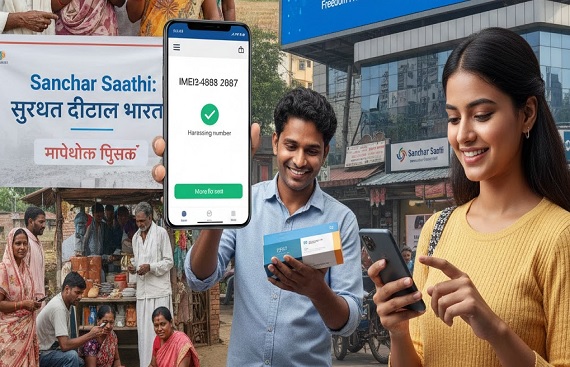
Sanchar Saathi's universality, it transcends brands, weaving into the fabric of India's multi-operator ecosystem. No siloed protections here, it's a unified front, accessible via app or portal at sancharsaathi.gov.in.
For rural users in Bihar, where smartphone penetration surges but cyber literacy lags, this could be the bridge to confident digital citizenship. Early adopters over 5 million downloads strong report fewer spam interruptions and quicker resolutions, turning potential victims into vigilant guardians.
Here's where the narrative fractures. Proponents envision Sanchar Saathi as the great equalizer in India's digital democracy. In a country where cybercrimes spiked 24% last year costing Rs 1.25 lakh crore this app democratizes safety. Small vendors in Tier-2 cities, armed with IMEI checks, sidestep counterfeit traps. Women, often targeted by harassment via fake numbers, gain a silent enforcer. It's not mere regulation, it's redefinition freedom from fear, where connectivity fuels aspiration without the shadow of exploitation.
“The number of users has been increasing rapidly, and the mandate to install the app was meant to accelerate this process and make the app available to less aware citizens easily.
Just in last one day, 6 lakh citizens have registered for downloading the app, which is a 10x increase in its uptake. Given Sanchar Saathi’s increasing acceptance, Government has decided not to make the pre-installation mandatory for mobile manufacturers”, the DoT said in a statement.
Summing It Up!
In redefining digital freedom, Sanchar Saathi teeters on a precipice. It promises a scam-free heaven, where India's youth innovate unbound by theft's specter. But true redefinition demands balance security as servant, not sovereign. If harnessed wisely, this app won't just guard connections, it'll ignite them, fostering a digital India where freedom thrives in safety's embrace.
The question isn't if it's redefining the landscape, it's how we shape the rewrite.